John Crome and Ithell Colquhoun books

I’d forgotten to mention that I’ve contributed to a couple of books earlier in the year. I wrote an introduction for the new edition of Ithell Colquhoun’s wonderful Cornish travelogue, The Living Stones, published by Pushkin Press.

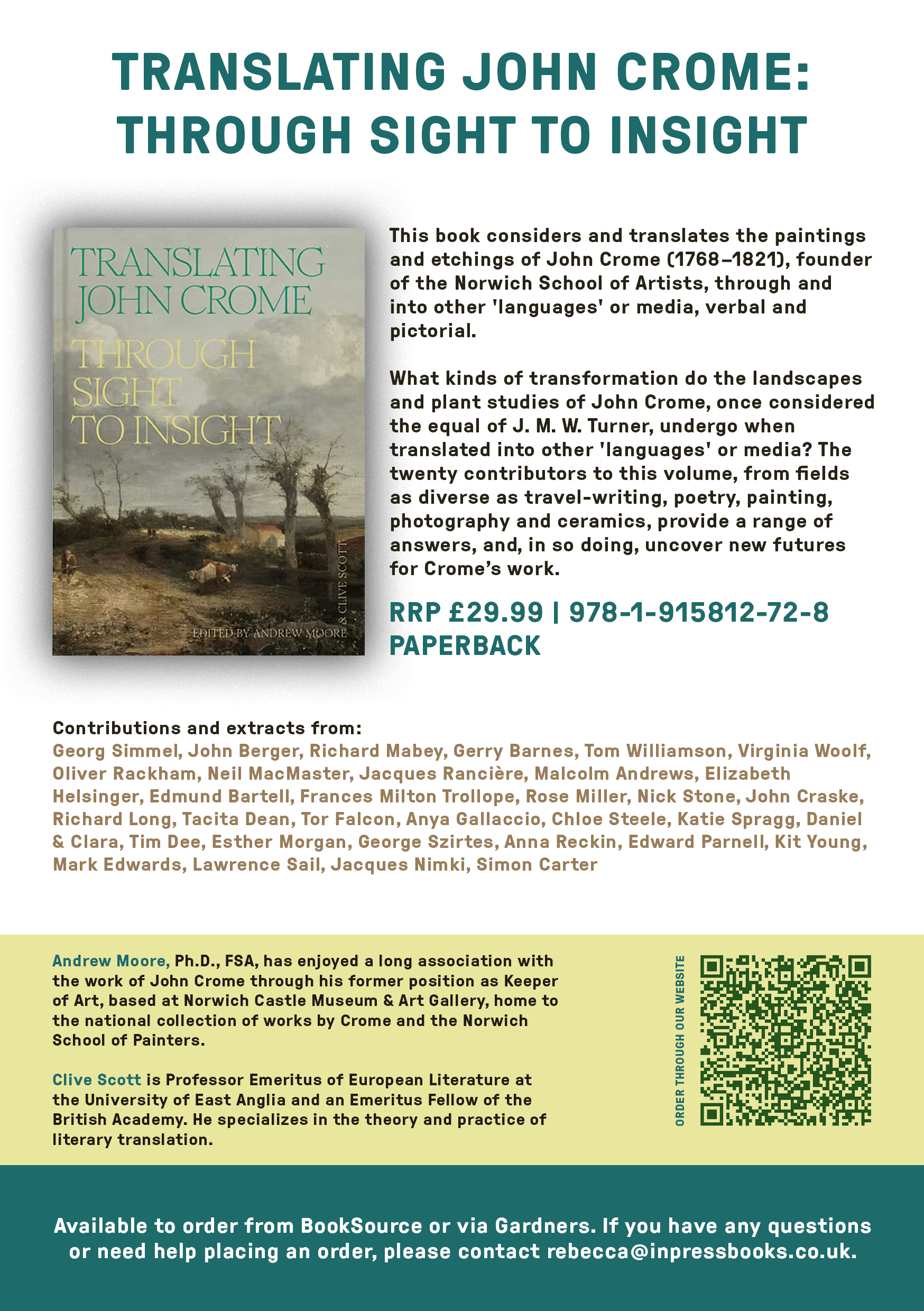
And I also contributed a chapter to a new book celebrating the work of the Norwich School artist John Crome: Translating John Crome (published by the UEA Publishing Project).

Argonaut Books Event – Tues 19th Nov, 7PM

A quick note to say that I’m excited to have been invited to do an event with fellow British Library Tales of the Weird editor Daniel Pietersen (I am Stone: The Gothic Weird Tales of R. Murray Gilchrist) this coming Tuesday, 19th November at 7pm in the lovely Argonaut Books of Leith, Edinburgh.
 

With Halloween now vanished into the autumn mist and midwinter fast approaching, we will be chatting about ghostly seasonal tales, including those seminal 1970s BBC ‘A Ghost Story for Christmas’ adaptations. There will certainly be diggin’ ‘ere!

 
Tickets are free, but do need to be booked in advance. There’ll be refreshments available too, I’m told, and ample opportunity to buy some signed books for Christmas presents!

Ticket are available from the following link:

https://argonautbooks.co.uk/product/19th-november-ghost-stories-for-almost-christmas-dan-pietersen-edward-parnell-7pm/

‘Eerie East Anglia’ – a new Tales of the Weird anthology

EDIT: This page has been updated to reflect the book’s publication.

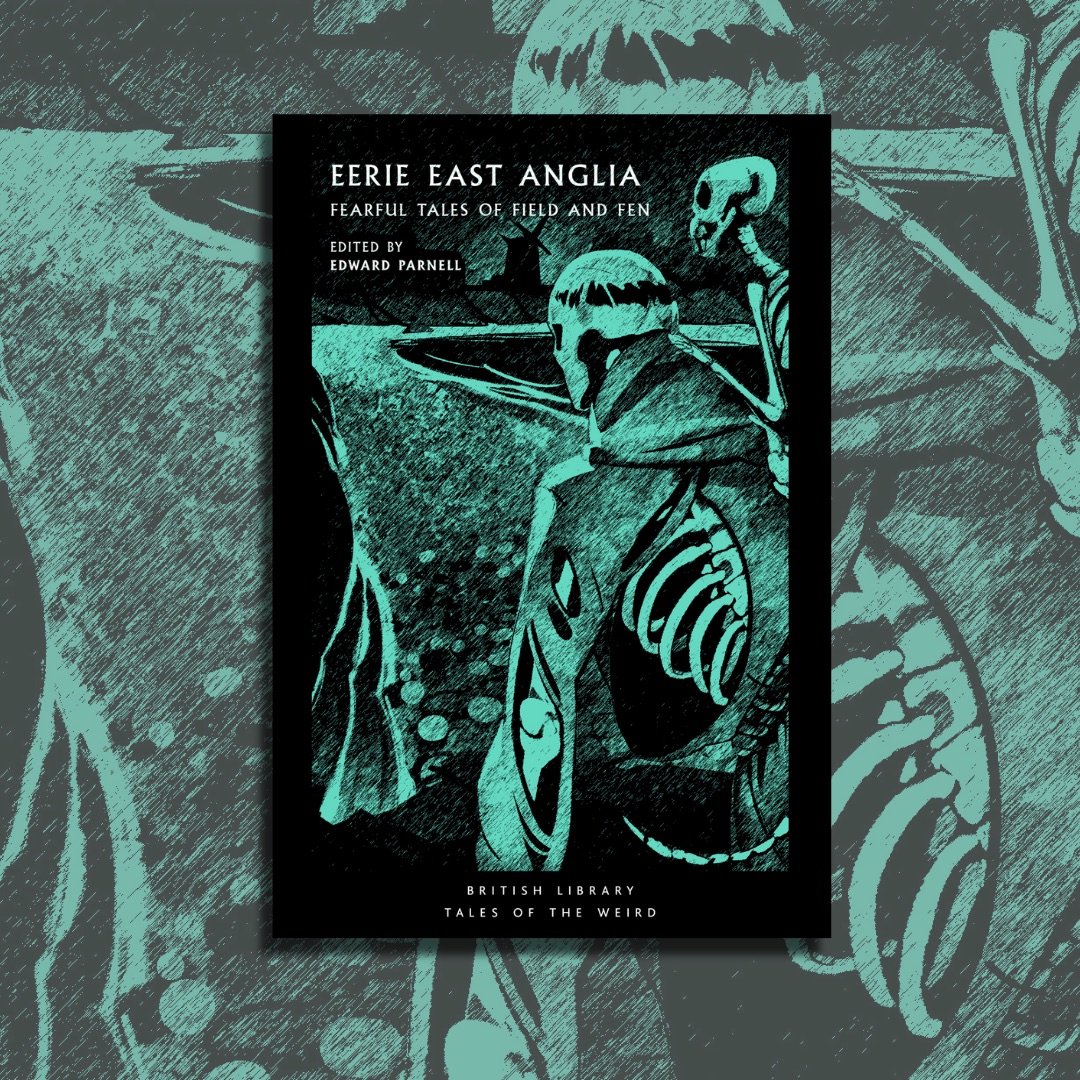
I’m excited about the new anthology I’ve curated and edited for the British Library’s Tales of the Weird series. It’s called Eerie East Anglia: Fearful Tales of Field and Fen and it was published in late August 2024. For further details and to buy on the BL website please click here.

As well as mostly vintage tales from the first half of the 20th century, the book also includes two more contemporary stories, by Matthew Holness (of Garth Marenghi and Possum fame – the original ‘Possum’ story is what we have here) and Daisy Johnson. There’s also an introduction from me, and headnotes for every one of the 17 stories.

It was upon a Lammas night…

As it’s Lammas today, I thought it appropriate to do a quick post about an upcoming illustrated Zoom talk I’m giving for The Viktor Wynd Museum and The Last Tuesday Society.

It’s titled It Was Upon a Lammas Night: Summerisle and The Wicker Man and is taking place on Thursday 14 September 2023 at 8pm UK time. In it, I’ll explore the real Scottish locations that make up the geography of the fictional Summerisle in the film, as well as talking about local history, folklore and the film itself. If you can’t make it live on the night then the event will be recorded for ticket-holders and a link sent the next day giving you a couple of weeks to catch up with it. There will be an audience Q&A session at the end, too.

I’m really looking forward to this, as it’s a great chance to revisit the time I spent in Dumfries and Galloway in Scotland researching The Wicker Man for Ghostland. I’ve also more recently visited other locations used in the film at Plockton up on the West Coast and the Isle of Skye.

Ticket details here.

Come of your own free will to the appointed place…

A New Year’s Eve ghost story…

New Year’s Eve is here, a night that features in an excellent ghost story by R. H. Malden, ‘Between Sunset and Moonrise’. I’ve written a short piece about it below, but to avoid spoilers you might want to read the original story first. It can be found on Project Gutenberg, here at: https://gutenberg.net.au/ebooks06/0605461h.html

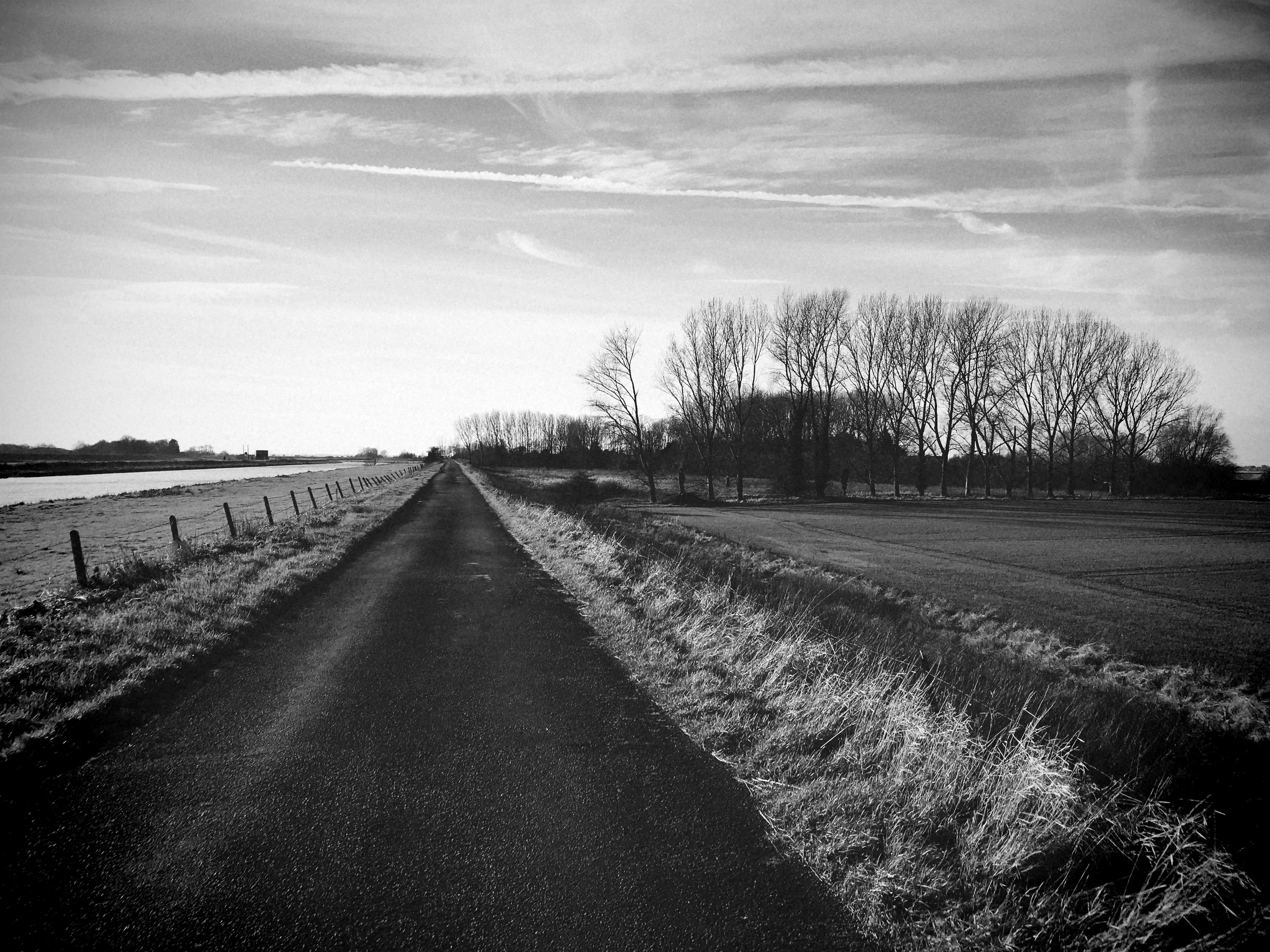
A Fenland drove. © Edward Parnell

*

Richard Henry Malden trod the same educational path as his mentor and friend, M. R. James, swapping Eton for King’s College in 1895. After graduating from Cambridge he became a deacon in Manchester, eventually rising to the rank of the Dean of Wells in 1933, a role he served until just before his death in 1951. R. H. Malden published only one collection of supernatural tales, Nine Ghosts, which was brought out during WWII by James’s publisher Edward Arnold, who made grand claims on the dustjacket: “Dr James has found his successor in the Dean of Wells.” 

Malden’s own introduction was more modest:

“It was my good fortune to know Dr James for more than thirty years… Sufficient time has now elapsed since Dr James’s death to make some attempt to continue the tradition admissible or even welcome to his friends and readers. It is as such that these stories have been collected and revised now. They are in some sort a tribute to his memory, if not comparable to his work.”

Dustjacket of R. H. Malden's 'Nine Ghosts'

Perhaps because of it being set in the Fens landscape of my boyhood, one of the stories in Nine Ghosts stands out to me: the atmospherically named ‘Between Sunset and Moonrise’. It utilises a typical M. R. Jamesian device of having a scholar uncover some papers that shed light on a previous mystery – in this case an unpublished posthumous testimony by the scholar’s late friend on the reasons behind his nervous breakdown and subsequent flight from his tenure as vicar of a remote Fenland parish, not far, we are told, from Cambridge. 

The unnamed vicar, who thereafter “was never the man he had been”, goes on to deliver his account of the events that led to his unnatural fear of these flush fields. We learn of the aquiline-nosed Mrs Vries, an old local woman who a couple of centuries before “might have had some difficulty in proving that she was not a witch”. Her residence, a decaying cottage at the end of a muddy drove, a quarter of a mile from her nearest neighbour and three miles from the nearest paved road or shop, is not easy to reach, and our vicar undertakes his occasional parish duty to visit her with a certain trepidation. On the afternoon in question, New Year’s Eve, he decides to get the dreaded task out of the way. After three knocks Mrs Vries finally answers her bolted door, and begrudgingly invites the priest inside.

On the table in front of him is the Bible, opened to the Book of Tobit – a slice of biblical apocrypha that MRJ translated in 1929 – and the story of Sarah and the fiend Asmodeus, the “worst of demons”. Asmodeus is a demon of lust, and tortures Sarah in the Book of Tobit by killing seven successive husbands on her wedding night, before the couple have had a chance to consummate the marriage. He is a fiend of whom James would have approved, a figure literally hell-bent on keeping sex out of the story. 

Depiction of Asmodaeus from J.A.S. Collin de Plancy’s Dictionnaire Infernal (Paris, 1863).

Leaving the nervous-seeming Mrs Vries, our vicar heads into the darkness of the late afternoon and his lonely walk home. A dense fog has enveloped his route and part-way back he hears a snort somewhere beside him, thinking it must be a cow in his way. However, he can see no sign of the animal and assumes it must be on the other side of the hedge. I can sympathise, as a few years ago while winter birdwatching on the marshes of the River Yare east of Norwich my car broke down at dusk on a track not dissimilar to that in the story. I had to wait for two hours in gathering gloom – my car battery had given up the ghost – for the RAC van to arrive; the night was coal-black when it did, and the mechanic nearly fell into the trackside ditch when a loud coughing emerged from the adjacent darkness. A herd of cattle had snuck up for a closer look at what we were up to, invisible to us until he illuminated them in his torchlight. I’d earlier been startled by their sounds, so could display cool indifference. In the story, however, the noise the narrator tells himself is the squelch of a hoof is only the opening of the horror to come:

“When I started again I saw that the fog seemed to be beginning to clear, though I could not feel a breath of air. But instead of thinning in the ordinary way it merely rolled back a little on either hand, producing an effect which I had never seen before. Along the sides of the drove lay two solid banks of white, with a narrow passage clear between them. This passage seemed to stretch for an interminable distance, and at the far end I ‘perceived’ a number of figures.”

These figures coalesce as they approach, merging into one awful vision of “intense malignity”. The narrator understandably collapses, feeling suffocated as the creature passes through and over him, with Malden painting a terrifying image of his character’s whole being becoming enveloped by the entity. Somehow, though, he manages to struggle home, the mist now clearing and the moon emerged. He overhears his housekeeper commenting to one of the maids about the folly of being “about the droves after dark” before he retires to bed, spending the next day there too as a result of a newly caught marshland chill.

When, finally, he arises on the following morning he learns that Mrs Vries has been found dead. The local constable had forced the back door to discover the lady sitting, stone cold, in a large wooden armchair, her fingers prised around her arm. A breath away another empty chair was facing her, its cushions “flattened down as it had been occupied recently by a solid personage”. The post-mortem showed that the woman’s heart was in poor shape, but the doctor informs the narrator that “if anyone ever died of fright, she did”. As the last person to see her alive, the vicar gives his evidence at the inquest: “I did not mention that the second armchair had stood in a corner of the room during my visit, and that I had not occupied it.” More odd facts and occurrences emerge, and we are left in little doubt as to the fate that has befallen the doomed lady, the youth who found her body commenting (in a turn of phrase that surely is a direct nod to a similar one utilised by a terrified boy in M. R. James’s ‘Oh, Whistle, And I’ll Come To You, My Lad’) that: 

“there was right houses and there was wrong houses – not to say persons – and that, they, had been after her for a long time.”

Darkplaces: Zoom event with Matthew Holness, 4 Dec.

I’m really excited to be joined by Matthew Holness (‘Garth Marenghi’s Darkplace’ and ‘Possum’) for a live Zoom event for the Last Tuesday Society on Saturday December 4th at 8pm (UK time). We’ll be discussing our favourite ghost stories and tales of the weird and eerie. The event will also be recorded so if you can’t make it on the night but purchase a ticket you’ll be sent a link to the recording afterwards. 

We’ll cover writers including M. R. James, Sheridan Le Fanu, Robert Aickman, Algernon Blackwood, Walter de la Mare, E. F. Benson and more, as well as hopefully finding time to discuss their own work.*

Matthew Holness is a writer, actor and director who wrote and starred alongside Richard Ayoade, Alice Lowe and Matt Berry in the 2004 haunted hospital-set Garth Marenghi’s Darkplace. The six-part Channel 4 series remains a cult classic and probably the greatest – perhaps the only? – eighties spoof comedy-horror series ever made for TV. More recently Matthew has acted in a number of television comedies and films, as well as writing, directing and starring in A Gun for George, a short feature about a delusional fan of British 1970s pulp crime novels. In 2016, he wrote and directed Smutch, a Halloween Comedy Short for Sky Arts, in which he played an embittered author haunted by a ghost writer. His debut feature-length film as a director came in 2019 with Possum, a hugely atmospheric and disturbing psychological horror film set in Norfolk, the county where he now lives. Matthew also writes stories of the weird and eerie, including most recently for the anthology Beyond the Veil (published October 2021). He also contributed the introduction to Swan River Press’s 2019 edition of Le Fanu’s Green Tea.

* Please be warned that in this evening’s discussion there will (probably) be blood. Crimson copper-smelling blood… And bits of sick.

For more info and tickets see:

Endings: Dead of Night

“If only I’d left here when I wanted to, when I still had a will of my own. You tried to stop me. You wouldn’t have done if you’d have known,” says Mervyn Johns’s troubled protagonist Walter Craig to Frederick Valk’s Freud-like psychiatrist Dr Van Straaten, prior to the inevitable, nightmarish end sequence of the classic 1945 Ealing Studios portmanteau horror film Dead of Night. Inevitable, because Craig is a man who wakes each morning from the same unconscious, barely recalled terror – and because he has already informed us how events are set to play out.

At the start of the film, Craig arrives in a reverie of déjà vu at a Kentish farmhouse he’s never previously visited, summoned there by a man he’s unacquainted with to look into redesigning the place. The architect has the dawning realisation that the house forms the backdrop to his nightly recurring dream, and that his fellow guests, all uncannily familiar to him despite their having never met, might be mere phantoms in his head.

Dead of Night contains five embedded narratives recalled by the occupants of the farmhouse. The first, adapted from E. F. Benson’s short tale ‘The Bus-Conductor’, concerns a premonition of an avoided future – its most memorable moment is the fateful line uttered by Miles Malleson’s bus conductor/hearse driver: “Just room for one inside, sir.” The next, a gothic children’s Christmas party that’s haunted by the ghost of a murdered small boy (loosely based on the actual murder of Francis Kent, whose sad story is told in detail in Kate Summerscale’s The Suspicions of Mr Whicher), is much more atmospheric, as is the third tale, that of an antique mirror that possesses its owner. Some questionable light relief is provided by Basil Radford and Naunton Wayne’s comedic, ghostly golf shenanigans (a reprise of their sport-obsessed cameo in Hitchcock’s 1938 The Lady Vanishes), before we come to the last and most celebrated of the stories, in which Michael Redgrave’s unhinged ventriloquist Maxwell Frere is driven insane by his papier mâché companion, Hugo.

However, it’s the film’s masterful, playful framing device, directed by Basil Dearden, that sets Dead of Night apart, providing both its end and its beginning. Because, at its climax we witness, once more, Craig’s identical arrival along a tree-lined country lane that followed on from the opening credits. First, though, we must spin back four minutes, to the moment Mervyn Johns’s character rises from his chair in the flickering, fire-lit lounge. 

Craig saunters towards the camera and the seated Dr Van Straaten, blankly demanding why he had to set into motion what’s about to come: “Oh Doctor, why did you have to break your glasses?” (Earlier, the visiting architect remembers that the moment his dream transforms into “a nightmare of horror” is precipitated by the breakage.) Craig towers behind the psychiatrist, removing his tie and strangling the larger man with a casual ease. A voice in his head urges him to hide and suddenly he finds himself in the familiar surroundings of the Christmas masquerade of the film’s second section.

Sally Ann Howes’s teenage Sally and a group of costumed children urge the murderer to join in their game of hide-and-seek. Craig flees up the same shadowed staircase Howes herself had previously traversed en route to offering comfort to the ghostly young Victorian victim, only this time the scene is skewed at an angle that recalls another film with a similarly mind-blowing ending: Robert Wiene’s masterpiece of German expressionism The Cabinet of Dr Caligari (1919). Next, Craig pauses in front of the haunted mirror of director Robert Hamer’s third segment, which shimmers in a psychedelic haze, prior to accosting Hayes and dragging her to the attic. There, he strikes the blow to her face he earlier predicted he’d be powerless to prevent.

Without warning, Craig is seated alongside the malevolent, foul-mouthed puppet from the final story (stylishly directed by Alberto Cavalcanti, as was the Christmas party segment). Hugo urges Craig to “take a seat, sucker”, as the camera pans around the gathered cabaret faces that leer down at the guilty man – and the audience. The strangler is carried aloft to a prison cell manned by Miles Malleson from the first tale: “Just room for one inside, sir,” he once more intones, this time with added relish. On the opposite side of the cell from where Craig cowers, sits Hugo, who, in the most menacing scene of the film, takes to his feet. The crowd of onlookers grin like hungry wraiths through the bars of the door as an undersized actor in dummy make-up strides towards Johns and places his hands on the architect’s throat, before the shot pulls rapidly back to reveal a silhouetted darkness. Now Craig is lying in the bland, comforting surroundings of his own house, awakened by the sound of the phone beside his marital bed that’s ringing to summon him, once more, to that all-too-familiar cottage. 

It’s a future of purgatorial dread and guilt that must hardly have been the uplifting tonic conflict-weary audiences were expecting when the film opened in London just one week after World War II had finally reached its own grim conclusion.

A version of this article first appeared in the January 2020 issue of Sight and Sound magazine.

Granite

My father was afflicted with an acute fear of heights. 

As we lived in the Lincolnshire Fens – the flattest part of the country – this was not ordinarily a concern. Once, on a weekend day trip to the coastal resort of Skegness (I hope the weather lived up to the town’s slogan and was suitably bracing) when I was small – five or six, I’d guess – he decided to take me on one of those chairlift amusement rides; I can’t say whether this was a spontaneous act of bravado on his part, or whether I begged him to go, though I suspect the latter.

We had to stand in front of a chalked line as the bench-seat swung up behind us – Dad was clasping my hand tightly – then quickly collapse ourselves onto the yellow plastic while he fumbled down the metal bar that fitted above our laps. I am reasonably certain that the route of the ride was a long straight line that looped and doubled back on itself along a parallel return cable. At least for one stretch, I think, it went out over the grey sea, though I may be imagining this. Certainly, I have a memory of looking down at my nonchalantly kicking legs, watching the distant brown waves break beneath my shorts-clad knees. Dad kept telling me to stop wriggling about, an odd note in his voice, urging me to sit back and keep hold of the bar. I thought it was great and was oblivious to the panic I can now see he was afflicted by. These terrors were partly a reaction to his own phobia, but mainly, as he told me later, because he was convinced that I would slide underneath the safety bar and drop off the bench into the waters below.

The other time Dad’s fear manifested itself was when we were on holiday. Certain routes took on a foreboding mystique in his head, so that he was loathe, for example, to drive along the dreaded Wrynose Pass when we visited the Lake District, or descend Exmoor’s mighty Porlock Hill. I, in contrast, used to love steep, winding little lanes, and on later holidays when I’d graduated to map-reading duties would deliberately send us along the atlas’ chevron-marked roads; I couldn’t empathise with why he felt uncomfortable driving alongside a vertiginous incline, or why he watched my brother and me scrabbling about on some acutely angled mountainside with a worried expression and shouted warnings urging us away from the edge.

I understand now, because I have become like him.

I find myself telling my nieces to stand well back from the lip of the cliff when we are on a walk along the Dorset coast, or nervously asking them not to move about after they persuade me against my better judgement to go on a Ferris wheel; this condition is one of the few things I can be certain my father and I both share. It started in my teens, a growing sense of unease when faced with a precipitous drop, where before there was none. If I’m enclosed I am fine – it’s the fall that holds the fear, not the height itself. Some of this dread stems from the inevitable thought that enters my head when faced with all that space below: what if I were to jump, what if I were to let my body plummet into the nothing? Should I do it? I wonder sometimes whether this is a Fenlander’s condition, whether the flatness I was born into is somehow encoded inside my very cells, replicating and spreading as I get older, so that one day even looking out of a second-storey window will be too much, forcing me to live out my days anchored down in some bland bungalow among those sterile plains in which I grew up. God, I hope not.
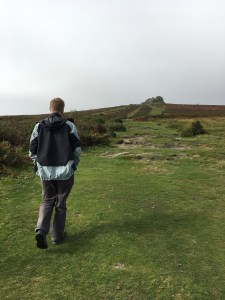
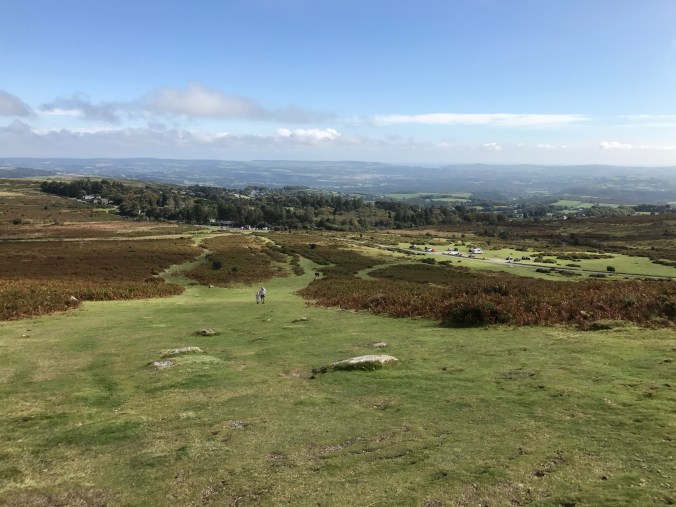
I thought about my father a lot during the writing of Ghostland, particularly when (during September 2017) I went back for the first time to the site of one of my most fondly remembered childhood holidays and revisited the rocky outcrops of Haytor, high on Dartmoor’s eastern flank. Here years before, around its rounded granite reminders of the last ice age, I’d climbed and played with my brother while Dad nervously photographed our exploits. Today the hill itself, though not especially big at a fraction below fifteen hundred feet, seems more than tall enough to my unfit lungs and legs as I trudge up from the visitor centre where fifteen minutes before a German man had rushed inside with a look of existential terror on his face that dissipated in an instant when he was reunited with the bag he’d mislaid full of fifty-pound notes and all of his travel documents. Halfway up, two men in their sixties are attempting to frame themselves in a portrait in which they appear to prop up the still-distant tor with their outstretched palms.

“Dunno how that one will work – it’s dark,” I overhear one say, as I pause to regain my breath.

Rested sufficiently to carry on, I make it to the brow of the hill. There, spread below, is the almost-identical overexposed vista that peers out from my remnant collection of photos and slides. Low cloud moves over the moor, shifting in patches to reveal fleeting features beneath – dank-looking ponds and mires, a loafing herd of cattle sheltering between gorse bushes, and a jumble of oddly shaped rocks – a dreamlike effect that seems like something straight out of a Powell and Pressburger film. The wind’s noise has a rumbling quality that is counterpointed by the high-pitched calls of a pair of meadow pipits, small brown-streaked songbirds that pick neatly around the desiccated cowpats in front of me for insects. It’s surprisingly busy and international up here, with unlikely clusters of people meandering around: an English woman in her seventies, presumably the grandmother, accompanied by two teenage Australian girls and her Jack Russell terrier; a group of four late-middle-aged Americans discussing whether they should visit Castle Drogo next; and a couple of local colleagues having a debate as to whether they perform a “high-skill” occupation – I try to work out what it is they do, but can come to no conclusion.

Now I’ve reached the more impressive lower outcrop – from the road it looks like the protruding sloped spine of some giant extinct animal, though viewed from behind it is a more uniform monolith – I decide I might as well attempt to recreate the ascent I made a lifetime ago, my own underwhelming version of conquering Everest. The rock’s surface is smooth and well-worn, and at first it’s not entirely obvious how the people taking selfies on the summit have made it up there. I watch one of them descend and realise there’s an ill-defined path in the granite – boot-rounded steps that were cut during the middle of the nineteenth century, once accompanied by a handrail that used to guide inadequate rock-climbers like myself to the top, before it rusted to nothing and was finally removed in the 1960s. Mid-way up I have to decide whether to jump across a two-foot chasm – not quite as dramatic as it sounds – in order to tackle the final climb. My uncomfortableness around heights is overtaking me: the space stretching vertically below appears huge, even though the drop cannot be more than three or four feet. The two Australian girls have gone on ahead of their grandmother, who stands at the base taking photos on her phone, when the terrier appears from nowhere and brushes past my stock-still form – his stumpy legs attempt the leap, only for his claws to lose their grip as he touches down, bouncing him into the crevasse. The girls squeal and I expect the worst but the terrier twists in mid-air and corrects his tumble, running off to his waiting mistress as if he had planned the acrobatics all along. Unnerved by the dog’s failed effort I follow suit and jump, my landing ungainly but safe against the lichen-pocked granite, from where it is an easy final ascent up the polished incline.
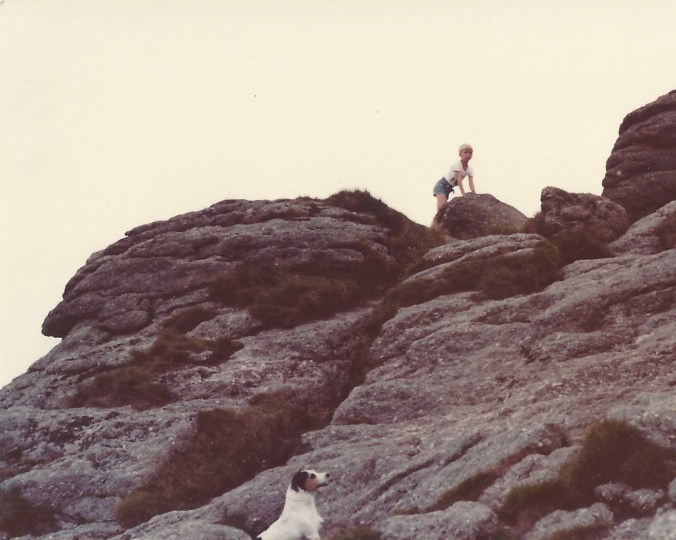
In an odd coincidence, one of the photos Dad took of me climbing up the Haytor rocks a quarter of a century before shows a similar Jack Russell gazing longingly up at the summit from the bottom of the frame.

In an odd coincidence, one of the photos Dad took of me climbing up the Haytor rocks a quarter of a century before shows a similar Jack Russell gazing longingly up at the summit from the bottom of the frame.

I am on top of the world, though when I peer over the edge that familiar urge to let myself fall flickers inside my head. I think back to the chair-lift over the fringe of the North Sea and realise that my father would have been in his forties when we undertook that airborne trip above the swirling breakers – an age I myself have now reached. This seems scarcely credible as I stand here.

Because for me he is immobilised in a series of moments – sitting next to me on that funfair ride, singing one of his various made-up ditties, or throwing his programme to the floor in exasperation as we watch our football team concede yet another inevitable late equaliser (“We always bloody do that!”) – in which he appears as a kind of middle-aged hologram, with a young version of myself flickering beside him for a few all-too-brief seconds. I search my memory for the reassuring grip of his hand around mine, though find only a vague recollection of his grain-tinged face grinning up at me from an old slide, one of his famous self-timer portraits where he propped the camera against a nearby surface and dashed round behind the two of us just in time for the shutter’s release.

From up here the panorama should be spectacular, but the fast-moving cloud remains fitful, obscuring more meaningful views except for a few momentary revelations. It is an odd impression, and I think I can almost make out white-capped waves way down in one of the valleys as an eddy of ashen air drifts past. My heightened angle, at least, better shows the geology of the nearby ridge of boulders that breaches the short distance across to the higher of the tor’s two outcrops. During the shooting of MGM’s 1953 CinemaScope epic Knights of the Round Table – starring Ava Gardner as Guinevere and Robert Taylor as her lover Lancelot – the miniature plain just below me, on which the façade of a castle was built, formed the backdrop to the film’s climactic joust and subsequent broadsword tussle-to-the-death between Lancelot and Modred.

Descending the tor’s summit is harder than going up, the return leap across the crevasse more tricky, but I make it intact – despite visions of bone-protruding compound fractures and an inelegant helicopter airlift to Torquay hospital, or at best a badly turned ankle – thanks to the proffered hand of a man waiting to ascend. At the base of the monolith the Australian girls are re-telling the dog’s exploits to their grandmother – “He nearly died!” – and as I go down the gorse-strewn path the mist, miraculously, is beginning to clear so that in the distance the real sea, the English Channel, is now visible, and everything in the world seems good.