
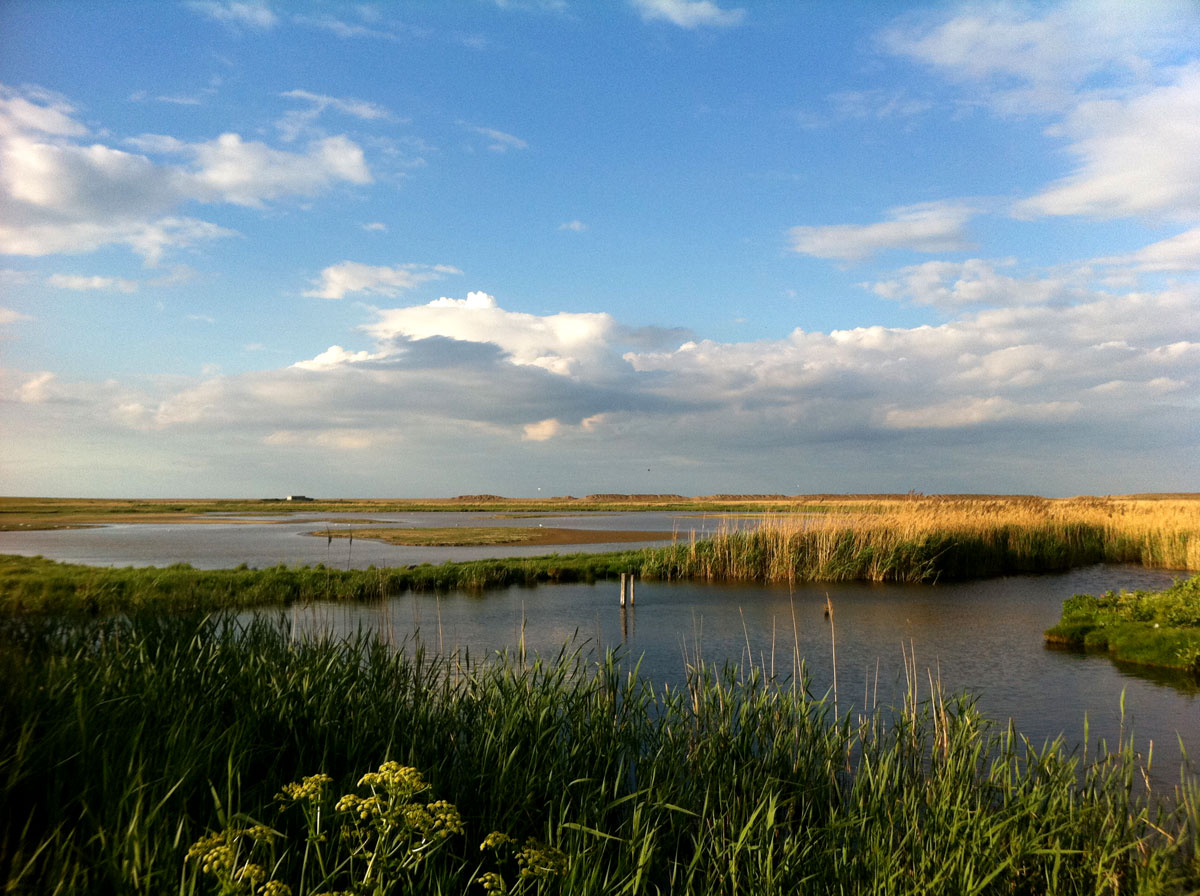
Big skies at Cley nature reserve.
When people think of Norfolk and its wildlife, their first thoughts are likely to drift towards the stunning open spaces of the coast, with their huge flocks of wintering geese and great gathering of waders. Or perhaps the vast reedbeds of the Broads, with their swallowtail butterflies and booming bitterns, spring to mind.
However, it wasn’t these impressive big-sky spectacles that first drew me, but instead the woodlands and gently undulating fields of central Norfolk, a landscape imprinted indelibly on my childhood. My grandmother lived all her life in a small village between Swaffham and King’s Lynn and, when we used to visit, the surrounding woods, meadows, glass-clear chalk streams and hollow-pocketed commons were a magical contrast to the flat Fenland horizons in which I grew up.
The woods were dark and dense, criss-crossed with half-remembered paths and tracks, thick swathes of nettles which we would have to hack back, and rickety planks that straddled narrow becks. Once, walking home at dusk, a friend and I watched a barn owl quarter the meadow, before landing nonchalantly in front of us on a fence post.
So when I got a place on the University of East Anglia’s Creative Writing MA, I suppose it wasn’t a surprise that these same woods and their wildlife should come to form such an important part of my novel, The Listeners, which is set in Norfolk at the start of the Second World War and features a nature-loving boy, William Abrehart, at its centre.
To help research the book I began to explore Norfolk Wildlife Trust’s lesser-known reserves, places that had an instant familiarity, replete with the same sense of magic I had felt in childhood. One of the first was NWT Wayland Wood on the outskirts of Watton. Initially drawn there by the presence of gaudy, introduced golden pheasants, I soon found myself coming under the spell of the place. Walking its rides in the late afternoon it was easy to get caught up in the atmosphere that seemed to linger about the trees, and to begin to believe that the events of the ‘Babes in the Woods’ legend really did occur among the wood’s thick cover. (I never have managed to see any of its golden pheasants, just occasionally heard their odd, piercing calls from somewhere off in the distance.)

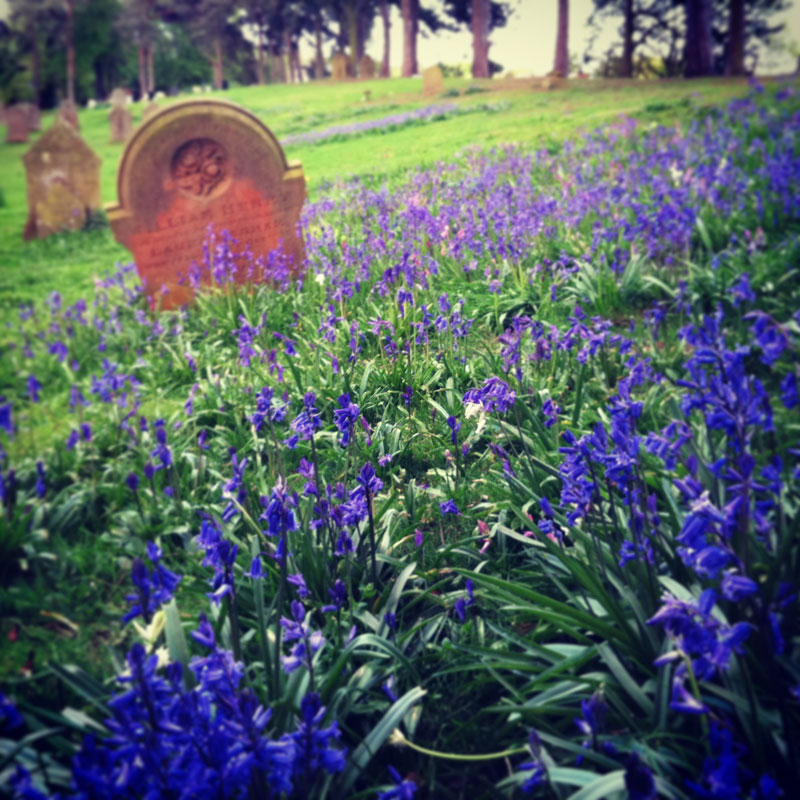
Bluebells in Wymondham Cemetery
NWT Lower Wood, Ashwellthorpe, a few miles from my home in Wymondham, is now also a firm favourite, particularly in spring when the air is heavy with the scent of wild garlic and the understorey carpeted with bluebells. The colours of these iconic flowers are chameleon-like: violet beneath the deepest shade, yet silvery lilac where the sun sneaks through the green gaps above. A walk there this Easter was enriched by the appearance of numerous early purple orchids, which emerged in path-side pockets, their vivid flowers pointing skywards in cone-shaped clusters. A sunny afternoon several weeks later and they had vanished, though various butterflies flitted along the tracks and blackcaps bubbled, unseen, from the depths of the trees.
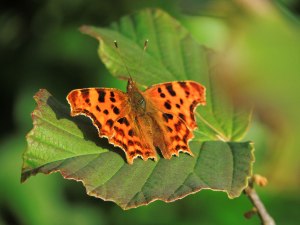
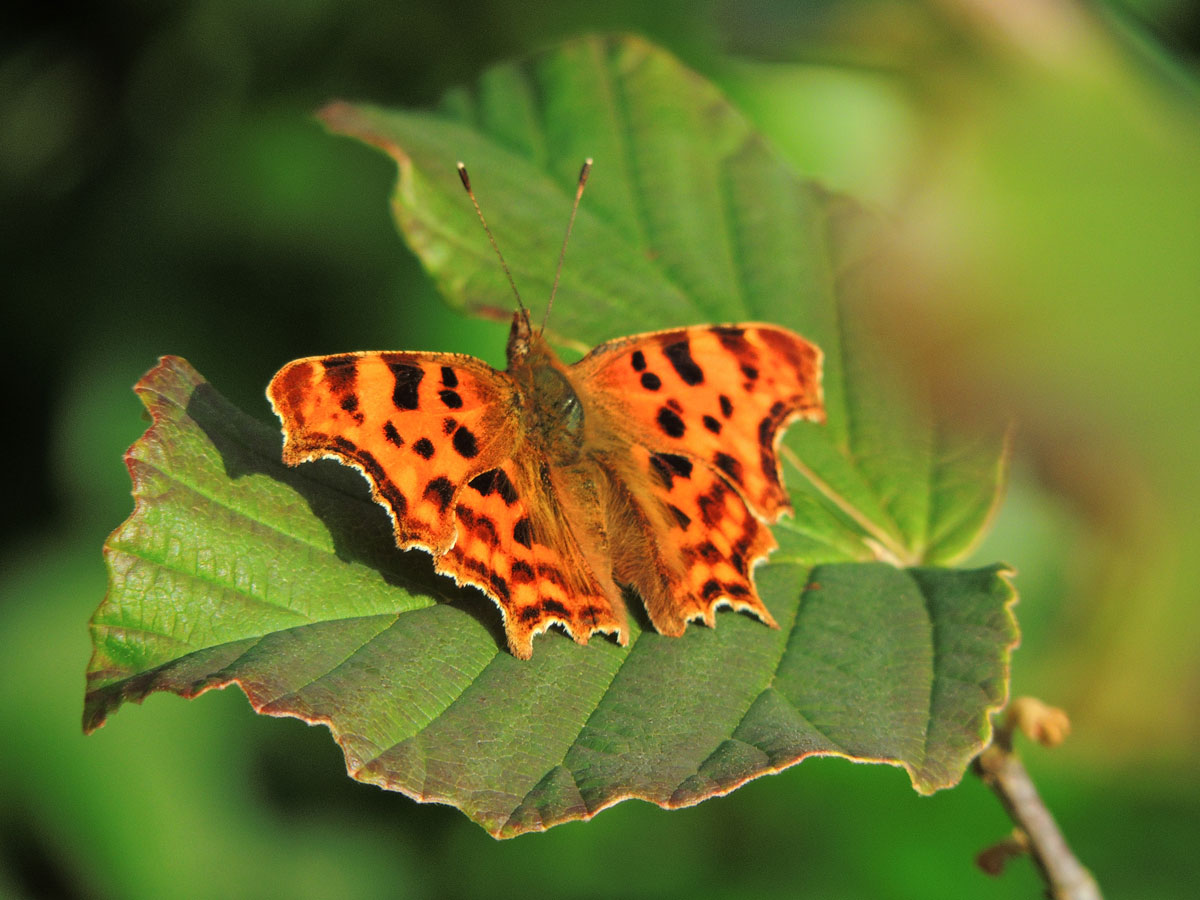
Comma butterfly
NWT Narborough Railway Line, is a disused railway embankment renowned for its wildflowers and butterflies. As well as the dingy and grizzled skippers of its chalk grassland, the reserve can be a surprisingly good place for woodland birds: a few years back it gave me my last Norfolk sighting of nightingale (sadly, this sub-Saharan migrant is declining across the UK and is probably no longer present at the site). A confiding individual piped its song from the edge of a hawthorn bush, perched in the open so that I could study how the russet of its tail contrasted with the rest of its plainer-brown upperparts. This was a species I had never managed to see growing up, though they would have been relatively common in the woods around my grandmother’s house then – I can still recall looking for them without reward – so finally seeing one just down the road brought things full circle.
If you do get the chance, it is well worth finding the time to visit these unfamiliar corners of the county’s interior. To me they are places loaded with possibility and mystery, a sense added to by local tales of German bombers which may (or may not) have been shot down nearby, or of bottomless pits in the woods that belong to the Devil… They are also, of course, havens for wildlife, and a wonderful way for people to connect with the Norfolk landscape and its history.
(A version of this article is published in the Winter 2014 edition of the Norfolk Wildlife Trust’s members’ magazine Tern.)




 Edward Parnell | Award-winning author of 'Ghostland'